
Some firms talk about crypto licensing as if it were some kind of checklist. Fill out this form. Pay that fee. Wait for approval. But anyone who has actually gone through the process knows better. The difference between a license in six months versus eighteen months comes down to who is handling the paperwork. The difference between a clean approval and a stack of rejection letters comes down to who is talking to the regulator.
This list features four firms that have done the work. Not once or twice. Hundreds of times across dozens of countries. They know which regulators have backlog issues right now. They know which banks are opening accounts for licensed crypto firms this month. That kind of knowledge does not come from reading news articles. It comes from submitting applications, getting responses, and doing it again until the patterns become obvious.
What Sets These Firms Apart
A crypto license service provider that has handled many applications sees things differently than one that has handled ten. They know which jurisdictions recently changed their interpretation of certain rules. They know which compliance systems actually hold up during an audit. They know when a regulator is about to tighten requirements before the official announcement drops.
The four firms listed here all operate at that level. Their reputations come from handling the messy parts of licensing that founders do not think about until they are in the middle of it.
1. Gofaizen & Sherle
Gofaizen & Sherle approaches licensing of crypto business like architecture. They have supported more crypto licensing projects than most firms will ever see, placing them among the industry leaders. That reputation comes from working across 50+ jurisdictions, where each application taught them something new about how regulators think.
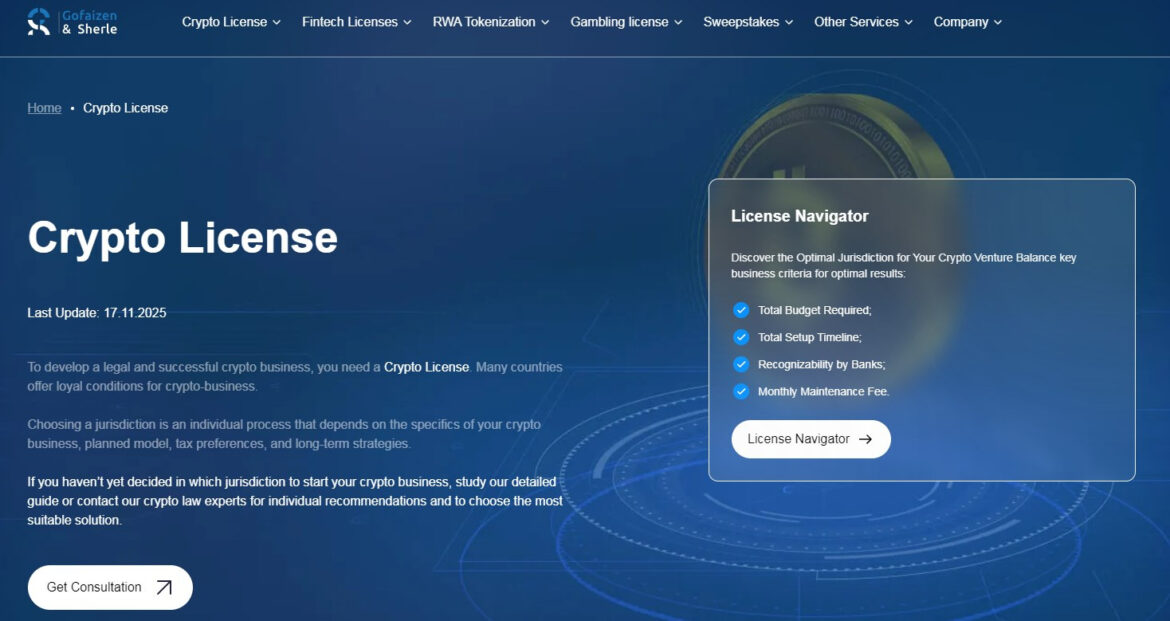
Their Crypto License Navigator tool helps clients skip the guesswork. Instead of asking “where should I go,” clients input their budget, timeline, banking needs, and monthly costs. The tool returns jurisdictions that actually fit.
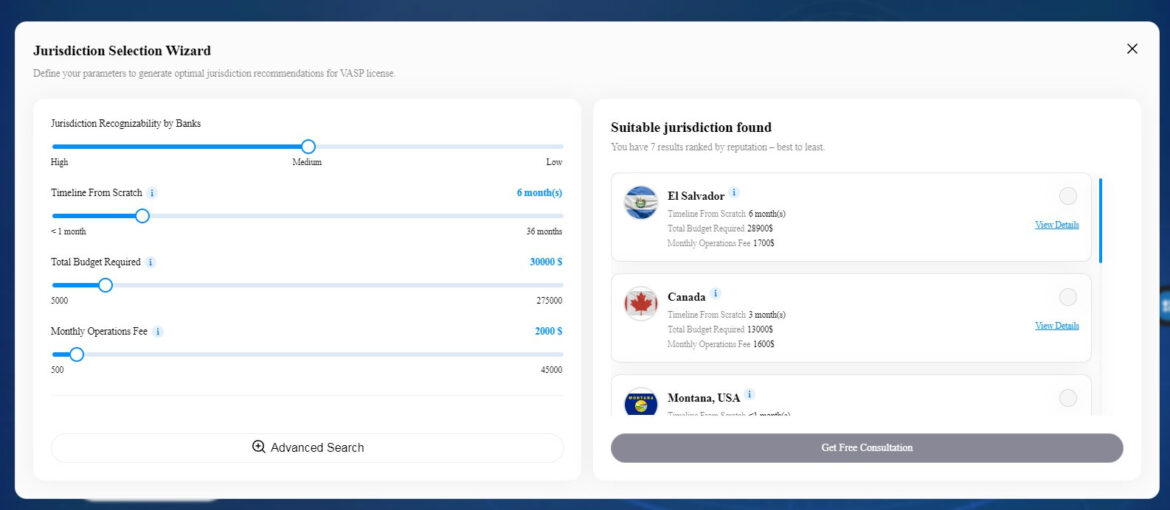
The firm also offers something most competitors do not: a track record in places like Canada and El Salvador that goes beyond basic registration. In Canada, they handle the two-tier system where federal MSB registration meets provincial securities rules. In El Salvador, they secured four of the roughly 40 DASP licenses issued so far.
Gofaizen & Sherle crypto lawyers say the most common mistake is picking a jurisdiction before understanding what services you will offer. A custodial exchange needs different rules than a pure payment processor. They make clients answer that question first.
What makes them different: They have helped clients hire over 200 professionals worldwide. They build regulatory structures that let companies add jurisdictions later without starting over.
2. DLT LAW
DLT LAW opened in 2017, which in crypto years makes them one of the oldest specialized firms still operating. Their partners had already been working with blockchain projects before the ICO boom turned the industry upside down. Offices in Tel Aviv, Cyprus, Dubai, Switzerland, and the US came later, as clients started needing coverage across time zones.
Their licensing practice does not treat applications as paperwork exercises. They start with a mapping exercise that identifies every regulatory touchpoint for the client’s specific services. A crypto exchange that also offers custody faces different licensing requirements than one that only matches trades. DLT LAW draws those distinctions before anyone submits a form.
When the application moves forward, they handle the full submission chain. Documents get assembled. Regulator questions get answered. The process runs from first filing to final approval with one team managing it all. Their regulatory strategy side sets up guidelines that keep clients operating within boundaries after the license lands.
The firm also runs a forensics unit that traces blockchain transactions when something goes wrong. A licensed exchange that receives frozen assets or faces a compliance audit uses that team to build evidence packages that regulators accept. They also handle commercial contracts, cross-border tax work, and token issuance structuring.
What makes them different: Their partners host a podcast that covers crypto law and policy. They teach at industry events. The firm does not take non-crypto work. A client gets a team that has been in the space since before regulators figured out what to call it.
3. Legal Nodes
Legal Nodes does not keep lawyers on staff. Instead, they vet firms across 22 countries and build a directory of specialists they trust. A crypto company comes to them with a plan. Legal Nodes figures out which jurisdiction matches that plan. Then they pull the right local firm from their network to handle the application.
The founders started this because they saw crypto companies getting overcharged by big law firms that assigned junior associates to learn crypto on the client’s dime. Legal Nodes charges a project management fee and passes the legal work to vetted local partners. The client pays one invoice and deals with one coordinator instead of tracking down five different lawyers across five different countries.
Their partners have handled licensing in places like the Cayman Islands, the British Virgin Islands, Lithuania, and Poland. The network covers jurisdictions where crypto regulation actually exists, not just the usual EU suspects. A company that wants options beyond the standard MiCA route can use their network to explore less obvious jurisdictions.
What makes them different: They operate like a general contractor for legal work. A client does not hire a law firm. They hire Legal Nodes to manage the process and bring in the right local specialists. The billing structure reflects this. Clients pay for project management, not partner hours.
4. Samson Solutions
Samson Solutions publishes their prices. Not ranges. Not “contact us.” Actual numbers. Anyone can see that Czech Republic costs 1,900 EUR and takes three weeks. Lithuania runs 6,500 EUR and takes eight weeks. Poland sits in the middle at 5,500 EUR for four to six weeks.
The firm focuses on five European countries: Czech Republic, Lithuania, Poland, Estonia, and Slovakia. They also handle MSB registration in Canada, which they mention in client testimonials.
Their model is straightforward. They do not try to sell clients on premium jurisdictions with long timelines and high capital requirements unless that is what the client actually needs. A startup with limited capital can get a Czech license with 1 CZK share capital and no office. A larger exchange that needs EU passporting can go through Lithuania with the full 125,000 EUR capital and physical office.
Clients mention their responsiveness in testimonials. One said they helped with accounting, AML compliance, and government communication. Another said they found an office and drafted policies alongside the licensing work.
What makes them different: They tell you the price and timeline before you ask. Three weeks in the Czech Republic. Eight weeks in Lithuania. No waiting for a consultation call to find out if you can afford it.
What to Look for When Choosing
Check their recent approvals. Not five years ago. Last year. In the country you want. Rules change fast. A firm that got approvals in Lithuania in 2023 may not know how the regulator behaves in 2026.
Ask who handles the regulator calls. Some firms assign junior staff to sit on the phone with regulators. Others put senior partners in the room. The difference shows up in how quickly questions get answered and how smoothly applications move.
Look at what they leave behind. Some firms deliver a license and a PDF of policies. Others install compliance systems, train your team, and stick around for the first audit. The second option costs more upfront but saves money when something goes wrong.
Ask about their network. Licensing requires more than legal work. You need bank accounts. Payment processors. Auditors. Firms with established networks in your target jurisdiction can open doors that would otherwise stay closed for months.
Final Thoughts
The firms listed here all deliver licenses. That is the baseline requirement. The difference is in what happens after.
Some hand you the license and disappear. Others stick around for the compliance reports, the regulator questions, the annual renewals. Some design your entire corporate structure so you can add licenses later without rebuilding everything from scratch.
A crypto license in 2026 starts a relationship that keeps going. Regulators expect regular reporting. They want to see policy updates. They conduct compliance audits. The license is the beginning, not the finish line. Working with experienced lawyers for obtaining crypto license means you get more than paperwork. You get a partner who understands how to keep your operation compliant as rules change.
The question is not just who can get you a license. It is who can keep you licensed. The best legal crypto consulting firms understand this distinction and build their client relationships around long-term operational support rather than one-off transactions.